Clergy Mentor
Certified lay ministry is a shared ministry involving the certified lay minister, the clergy mentor, the mutual ministry team, the congregation, and the district superintendent.
The clergy mentor serves as the primary clergy partner for the CLM, offering guidance, support, and supervision throughout the discernment, formation, and ministry process.
By Discipline, the district superintendent assigns a clergy mentor for each certified lay minister. When CLMs serve in ministry within their home congregation, their pastor usually fills this role. If a CLM is assigned to another congregation as a lay pastor, another clergyperson may be assigned as clergy mentor.
Supporting Discernment
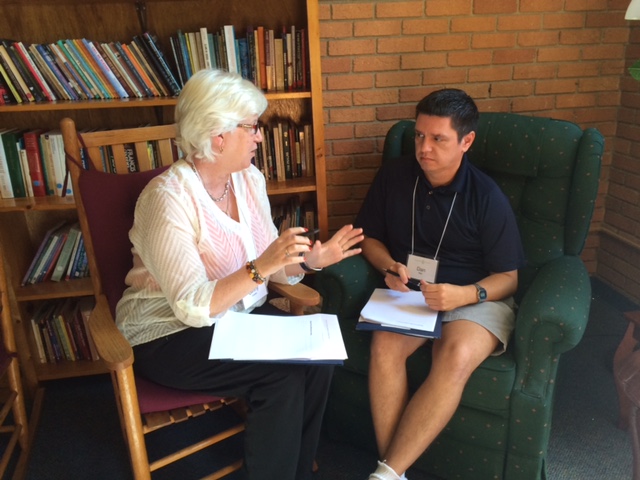
Laity considering certified lay ministry are asked to begin by talking with their pastor. During this stage, clergy mentors help laypersons discern their call, engage church leadership, and, if the church supports the candidate moving forward, prepare for the application process.
Early Discernment Conversations
- Meet with the layperson to hear their story and understand their sense of call.
- Use The Christian as Minister as a guide for conversations about vocation and the various forms of ministry within The United Methodist Church.
- Help the layperson understand the ministry of the laity and discern whether certified lay ministry is the appropriate next step in responding to their sense of call.
Engaging Church Leadership
- Encourage conversations with the S/PPRC and church council early in the discernment process, knowing their affirmation will be required for the application to the Candidate Training Program.
- Consider inviting the prospective CLM to share their sense of call and vision for ministry with the S/PPRC and church council. These conversations can help lay the groundwork for the team-based ministry that will support the CLM throughout training and ministry.
- Help the candidate and congregation begin thinking about the ministry needs, opportunities, and gifts that may eventually shape a ministry covenant.
Supporting the Application Process
- Complete the pastor recommendation when the candidate applies.
- Talk with the S/PPRC chair and church council chair about their recommendations.
- Review the cohort schedule with the candidate and key church members. The in-person cohort gatherings are required parts of the program, and churches should avoid scheduling responsibilities that would prevent the candidate’s participation.
Resources: CLM Overview, How to Become a CLM
Supporting a CLM Candidate
Mutual Ministry Team
- Help the candidate identify potential members of the mutual ministry team (MMT).
- Encourage a team that knows the congregation, understands the candidate’s gifts, and is willing to provide honest feedback and support.
- Participate as an active member of the team throughout the training process.
Timeline: The MMT is formed during Module 1 (October). During Module 2 (November–January), the candidate reviews congregation assessment work with the team. During Modules 3 and 4 (February–March), the MMT and candidate develop and finalize the ministry covenant.
Ministry Covenant
The ministry covenant is more than a requirement for certification. It serves as the shared ministry plan developed by the CLM, clergy mentor, and mutual ministry team. After certification, it becomes the foundation for ongoing accountability, annual covenant review, and ministry evaluation.
Clergy mentors play a key role in helping the candidate and the MMT discern a ministry that responds to the congregation’s needs while building on the candidate’s gifts, experience, and sense of call.
For Candidates Discerning a Lay Pastor Assignment: If a CLM candidate is in conversation with the district superintendent about a possible assignment as lay pastor in another congregation, the clergy mentor should be in conversation with the CLM, DS, and CLM Registrar (lsm@nccumc.org) to determine the best process for developing a ministry covenant for that ministry setting.
Continued Discernment and Support
Throughout the Candidate Training Program, the clergy mentor provides ongoing support through regular conversations with the CLM candidate. These meetings are intended to integrate what the candidate is learning, how they are growing, and how their ministry context is shaping their formation.
In these conversations, clergy mentors are encouraged to:
- Stay familiar with the candidate’s module work and additional formation experiences (e.g., Intercultural Development Inventory, anti-racism coursework, Safer Sanctuaries training) and use it as a shared framework for reflection and discussion.
- Help the candidate connect course content to their local ministry setting and emerging sense of call.
- Support the candidate in reflecting on their mental health and wellness assessment and in preparing for conversations with the district committee on ordained ministry (dCOM), including vocational clarity, ministry reflection, and personal readiness.
- Attend to the candidate’s spiritual and emotional well-being as they move through an intensive formation process.
Resources: Candidate Training Program, Church Team; Ministry Covenant (with template)
Supporting Ministry After Certification
Supervision and Support
The clergy mentor continues to:
- Encourage ongoing spiritual formation and discernment.
- Meet regularly with the CLM for reflection, support, and accountability.
- Provide a recommendation each year when the CLM submits their annual report.
- Help connect the CLM’s ministry with the mission and ministry of the congregation.
- Support the CLM in responding to changing ministry opportunities and challenges.
Covenant Review
Covenant review is a shared responsibility of the clergy mentor, CLM, and mutual ministry team (or equivalent church body such as church council or SPRC), who review and approve updates annually. As clergy mentor, your role can be especially helpful in guiding discernment around needed changes and continued equipping that can help the ministry to remain fruitful in the long term.
Ministry Review
As part of their recertification every two years, the CLM will need a ministry review conducted by the church council, SPRC, or other appropriate group at the church where they are assigned. The clergy mentor supports this process and can work with the CLM to identify the best group to complete the review and the appropriate representative to complete the ministry review report, which will become part of the CLM’s recertification file received by the dCOM.
Resources: How to Renew; Ministry Review
FAQ
How often should I meet with the CLM?
Meet regularly enough to support ongoing formation and accountability. Most mentors find monthly or every 4–6 weeks to be a helpful rhythm, with additional check-ins during key milestones in the training year. After certification, a less frequent rhythm may be appropriate as the focus shifts to ongoing supervision and covenant accountability.
Does the Mutual Ministry Team continue after certification?
Certified lay ministers always operate within a team-based structure. After certification, a congregation may shift ongoing accountability from the Mutual Ministry Team to an existing body such as the SPRC or Church Council. The appropriate structure is determined by the needs of the ministry context. See Church Team for more information about the ongoing role of this team.
What happens if I am appointed to a church that already has a CLM?
When the outgoing pastor has been serving as the CLM clergy mentor, the incoming pastor is likely to assume this role. The district superintendent, CLM, and incoming pastor should be in conversation about the mentoring relationship.
The ministry covenant is a living document and may be revised as ministry leadership or context changes. When there is a change in pastoral leadership, the incoming pastor and CLM should review the covenant together, along with the appropriate church team, to discern whether updates are needed to reflect current ministry realities and shared goals.
What options are available when a CLM is no longer active in ministry?
CLMs may move into inactive status (for up to four years during a season of transition) or retired status. These status options provide structured ways for individuals and congregations to celebrate completed ministry and to create space for discernment in times of transition. Any status change should be communicated with the district superintendent and the CLM Registrar (lsm@nccumc.org). CLMs in inactive or retired status are not expected to complete annual reports, ministry reviews, or dCOM interviews.