
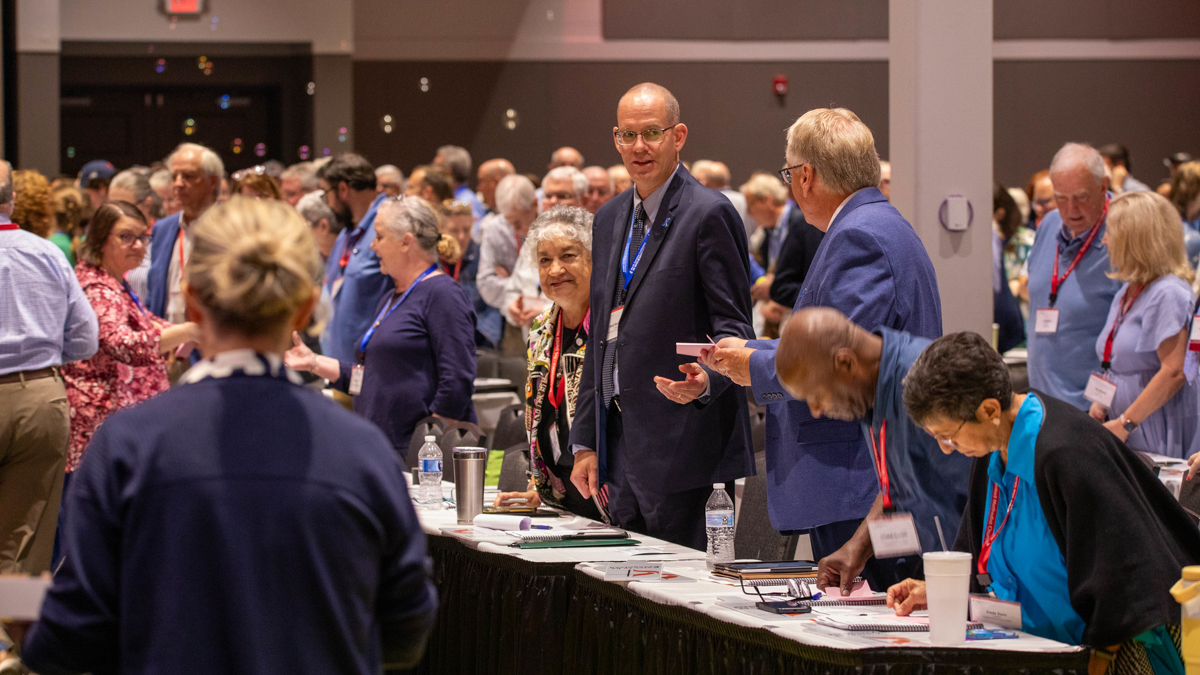
On Friday afternoon, lay and clergy members of the NC Annual Conference continued the amendments voting process by addressing the final two amendments to The United Methodist Church’s Constitution recommended by General Conference in 2024. Ballots for Amendments 1 and 2 were completed on Thursday afternoon.
Bishop Connie Mitchell Shelton began the plenary session by reading a prayer from Rev. Dr. Paul Chilcote. Offering logistical instructions, Annual Conference Secretary Rev. Dr. Gray Southern reminded those gathered that results of the NC Conference balloting would not be announced. Because the final results of whether or not the amendment passes depend on the complete, aggregate vote from all annual conferences, results from individual conferences are not relevant and may negatively impact future voting. He also reminded those voting that any ballot returned with something written on it other than marking “yes” or “no” would be considered a “no” vote. He asked persons who want to abstain to refrain from turning in a ballot.
Before each ballot was taken, members from the floor were able to offer speeches for and against the amendments.
Ballot #3 – Amends Section I, Article V (¶ 5) addresses Racial Justice and serves as a framework for The United Methodist Church’s commitment to addressing and eliminating racism in all its forms. The proposed changes take an explicit stand against racism, racial inequity, colonialism, white privilege, and white supremacy within the denomination and in broader society. It commits the denomination to confront all elements of systemic racial injustice.
Ballot #4 – Amends Section VI, Article III (¶ 35) clarifies the educational requirements for clergy allowed to vote for clergy delegates to General Conference. This amendment ensures that those voting for clergy delegates have met the denominational standards for theological education. It does not expand or restrict voting access for licensed local pastors (LLPs) in central or regional conferences. Instead, it clarifies the meaning of an M. Div. degree and specifies qualifying theological schools and their equivalents. This amendment brings greater clarity and consistency to the voting process for clergy delegates while allowing for necessary contextualization within central and regional conferences.
Worldwide Voting Process
Members of all annual conferences throughout the world are voting on the four recommended amendments at their annual conference sessions. Ratification requires two-thirds of the aggregate total votes to amend the constitution.
Because conferences meet at varying times throughout the year and since only the final tally of votes determines the outcome, individual vote totals from annual conferences are not shared. The final, aggregate tally of votes will be announced after all conferences have voted and their results certified by each annual conference secretary. A final report from the Secretary of the General Conference is not expected to be shared until later in fall 2025 or early 2026.
Tellers distributed ballots to individuals eligible to vote (clergy in full connection who are assigned blue lanyards and lay members of annual conference who are assigned red lanyards). Details about lanyards and voting status are included in the conference workbook on page 7 and online at nccumc.org/ac2025/voting.
Resources from the NC Conference and from the denomination are available at nccumc.org/ac2025/voting/amendments.