
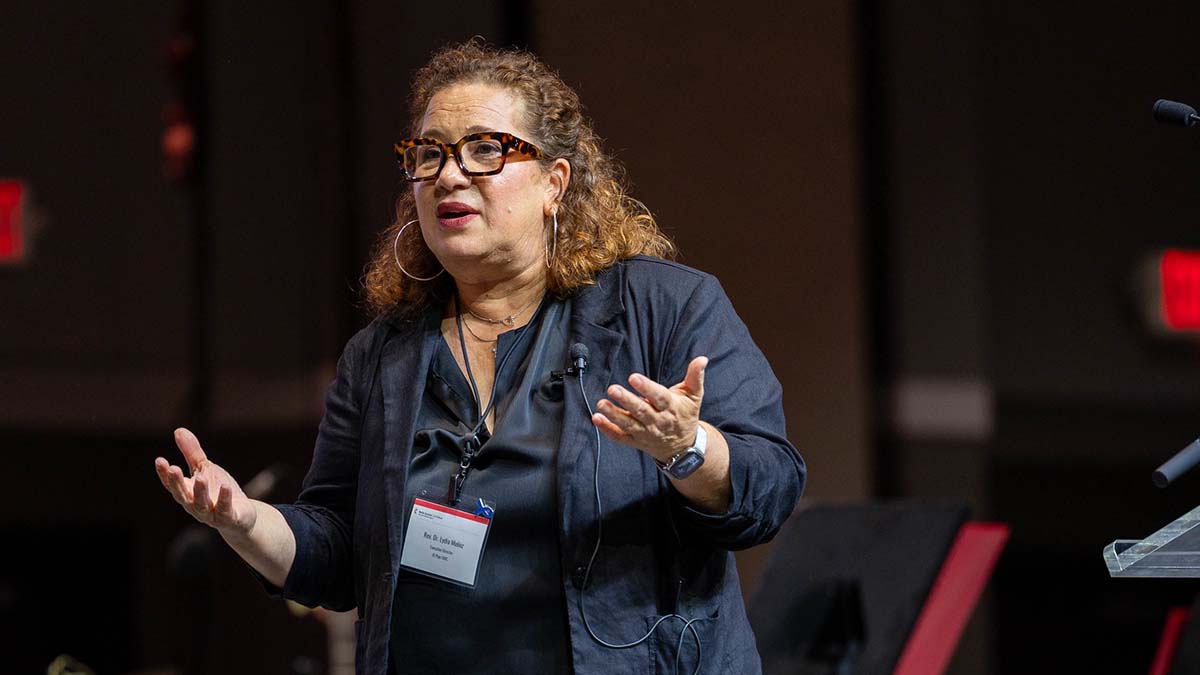
The NC Conference members reconvened after lunch Friday afternoon. Rev. Luz Ponce and the Unidos Por Cristo Band led the conference with a time of worship. After a special time to recognize the new retirees and their spouses, Rev. Dr. Lydia Muñoz ignited the stage as the featured speaker for a session addressing loving boldly through peace building.
Muñoz is the Director of the National Plan for Hispanic/Latino Ministries, one of six ethnic plans for The United Methodist Church. A product of the National Plan herself, she is an Ordained Elder in the Eastern Pennsylvania Conference and has served in Philadelphia, as well as the Florida, Baltimore-Washington, and Susquehanna Annual Conferences. She is a strong community activist with a seasoned ministry focusing on developing ministries of justice among marginalized and multicultural communities.
Muñoz expressed gratitude for being invited to speak and acknowledged Bishop Connie Mitchell Shelton as a leader who thinks and prays strategically. Muñoz stated that Shelton embodied this by extending an invitation to her to lead the conference in considering deeper ways to think about peace building.
The session began by remembering the history of ministry with the Hispanic/Latino community. In 1988, The UMC started thinking about ways to minister with this specific population, creating a study followed by a strategy to respond. As a result of this study, the office for Hispanic/Latino ministry opened in 1992.
The Spirit of Acompañamiento, or the spirit of accompaniment, was described by Muñoz as the essence of what guides the National Plan, vision, and ministry as they accompany United Methodist conferences to create plans to do the same. In fully defining this concept, she talked about songs and stories that connect us to memories and places. She recalled being a shy 13-year-old with a song in her heart, a song which accompanied her throughout her life.
Muñoz reminded us that the accompaniment is an integral part of a song, the part of music that provides rhythm or harmony to the main melody. Leading music, she said, is knowing it’s more than what’s written on the page, and it requires us to listen deeply and intensely in order to follow or enhance the song. In other words, the job of accompaniment is not to overshadow the melody but to come alongside and allow the melody to expand.
“In these days we are living, what is the melody you’re hearing in your community?” Muñoz asked. The conference members were invited to discuss this question and share song names from the floor. She then shared a quote from Jeffrey Pepper Rogers in Acoustic Guitar Magazine: “The accompaniment is about serving the song.”
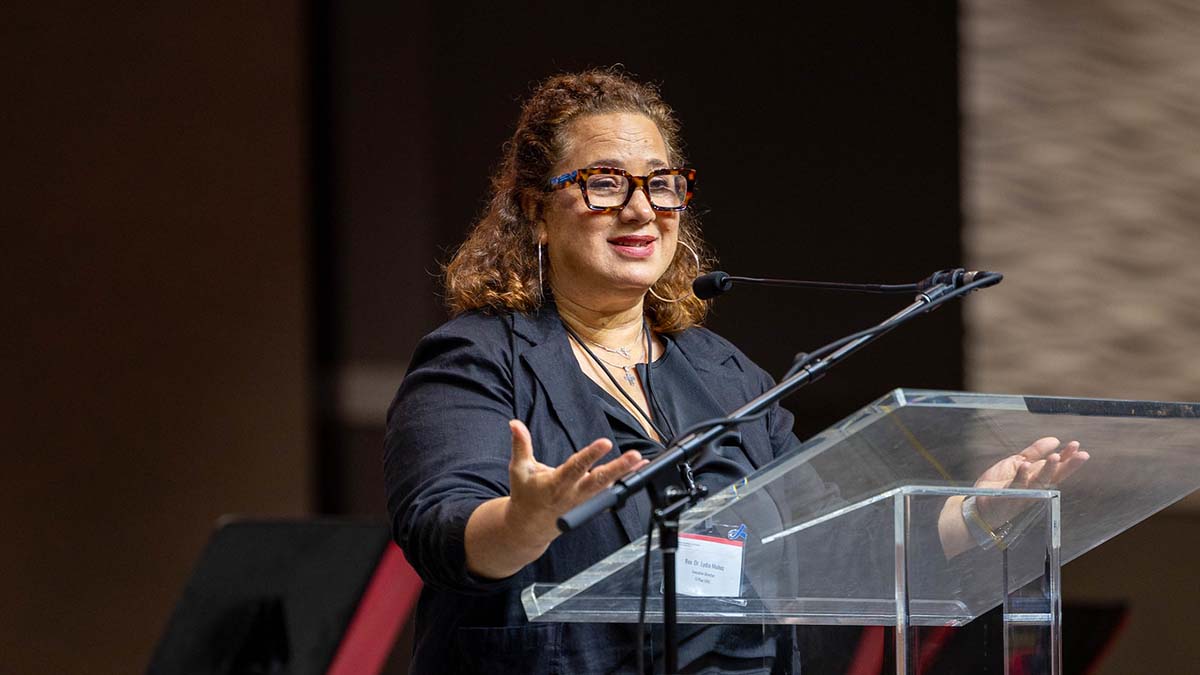
Muñoz said that through the years of ministry, The UMC has learned three key aspects about successful accompaniment. Deep listening first, instead of acting first, is the starting place. In humorously reflecting on the difference between deer in her hometown of Philadelphia and NC, she said she learned that deer can best hear “the murmuring under our breaths.” This led to questioning whether we are listening to only the excitement and accomplishments, or are we daring enough to listen to the thing flowing underneath the radar, including people who don’t feel like they have a voice.
The conference was reminded that deep listening requires us to step back sometimes so others can step up and that we must “go slow to go fast… the journey is part of the process.” She encouraged us not to walk around the history of a community, but into it, and allow it to accompany us as a sense of integrity and deep care for that community.
The second important tool of the Spirit of Accompaniment is discerning in community. “It’s important to look around to see who’s part of the conversation, but also who’s not part of it. What is the problem? What is the source of the problem?” Muñoz asked. “But the deeper sanctified question is: how have we been complicit in the problem?” She encouraged us to allow the Holy Spirit to open up the proverbial backpacks that we all carry and to clean out all the “stuff.”
The final piece of the accompaniment puzzle is acting or collaborating with the community. While we often think we’re going into a community with many answers to remedy it, she recalled a pastor cautioning her with, “Have you ever thought that Jesus is already there?” It was a gripping reminder to her of the need for us to allow the community to lead us into where the Holy Spirit is guiding us.
As Muñoz concluded her time with the conference, she mentioned that much is happening in the world where public witness of the church is more important than ever. “Communities are being devastated. We experienced COVID, but now in my community, it’s the worst pandemic I’ve ever witnessed.” She shared she had received two calls from bishops during our annual conference about situations in which Immigration and Customs Enforcement (ICE) had shown up and taken congregation members away from their community worship spaces. As a benediction of sorts, Muñoz invited us to again consider that accompaniment might mean we have to take the uncomfortable walk together or even place our bodies in front of the vulnerable ones, “because God is there. God is moving when we reach into the community and try to create a sanctuary.”
Our Annual Conference community was then led by Muñoz in an a cappella singing of “Sanctuary,” followed by the Unidos Por Cristo Band returning to the stage with the song, “We Are One Body.”